

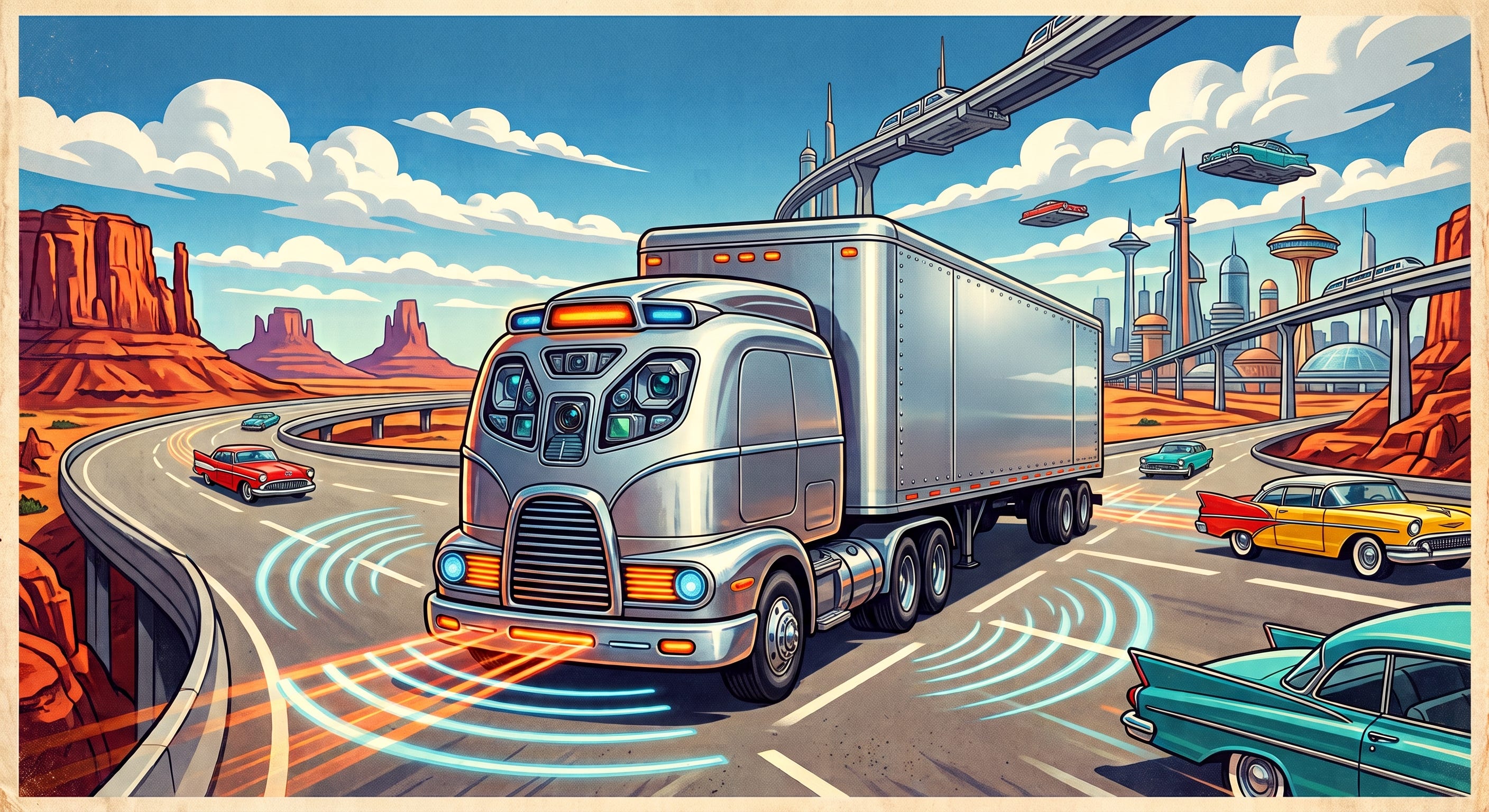
Just a couple weeks ago, Aurora Innovation released its second-generation self-driving truck. As of June 2026, Aurora had driven 440,000 miles with its autonomous vehicles, and secured an agreement with Hirschbach Motor Lines, a major freight carrier, to purchase 500 Aurora-powered vehicles. With production of the new vehicles by Rousch to ramp up to 1000 vehicles next year, it’s time to revisit the story of the often-delayed self-driving truck.
Logistics is a crucial area for robotics. Trucks move over 30 million tons of goods across the United States every day, but truck drivers are in serious demand. The hours are long and the work hard; accreditation and compliance costs are high, so despite good wages, it’s growing more difficult to hire drivers.
And the task, at least on the face of it, looks like one that should be straightforward to automate. It seems well defined: the task mostly involves driving down the highway along a known route.
And yet self-driving trucks have appeared on the verge of takeoff for a very long time without making much progress. Finally, in 2026, ten years after the self-driving car explosion of the mid-2010s, we finally have what seems like signs of life for the sector.
Aurora Begins to Expand
Things are finally starting to look up for the self-driving semi truck industry, which in the early 2020s was a graveyard of failed startups and R&D projects. I’ve written about this before, but examples include:
TuSimple, which saw a meteoric rise followed by a dramatic retreat from the United States
Waymo and Uber, both of which started then abandoned self-driving truck efforts
Locomation and Starsky Robotics, which shut down
Embark Trucks, which went through a SPAC, crashed, and was acquired
Tesla, whose electric semi effort is still crawling along but has not yet scaled
Kodiak Robotics, which pivoted from interstate highways to hauling frac sand in constrained environments
It should be noted that there have been real commercial successes in automated trucking. Kodiak didn’t die so much as pivot away from highways (perhaps one day to return); they have a good business with ~35 trucks in 2025. But the dream of interstate trucking was largely delayed until now.
Aurora now has a customer commitment for 500 vehicles, and 440,000 miles driven on ten different driverless routes through the US Sun Belt. That’s a significant expansion from what we’ve seen in the past, and seems to mark the beginning of real product readiness.
They had to address a tremendous number of technical issues to get here, which tells us something about how hard the underlying problem is.
Highways Are Hard
There was a huge boom in self-driving truck companies about 10 years ago, most of which have failed by now — in fact, failing even more dramatically than the self-driving car companies of the same era.
Why? A combination of regulatory concerns, safety issues, and the fundamental difficulty of the technology. A self driving truck has a much larger stopping distance than a self-driving car, and needs to operate at much higher speeds. The danger to others on the road is substantially higher; while Tesla can deploy self-driving in passenger cars relatively easily, as there’s a human there to take liability in case of an accident, the situation with a truck is much less clear.
And the technical difficulties cannot be understated. Even now, in 2026, it’s hard to find a self-driving car — a truly autonomous one, without a human at all — which can take you on the highway. Only the aforementioned Tesla gets close, but these still don’t drive to you without a human at all! Waymo, for example, will take you to San Fransisco International Airport, but as of August 2026 only via the back roads to the Rental Car Center.
This is in spite the initial thought that highways would be easier than driving on city streets. For humans they certainly are; who amongst us has not zoned out for a second while driving on the highway because it’s just so boring? And yet when looking at the performance of an automated system, we care about its potential for catastrophic failures, not it’s success rate — and the potential for catastrophe on a highway is so much higher. Stopping distances are much longer, giving vehicles far less time to react effectively — and the problem is even worse for trucks, as I have written about before.

More to the point, taking the driver out of a self-driving semi truck on the highway requires replacing a whole system. A damaged Waymo or Cybercab on the highway doesn’t require special handling, but an automated semi might block multiple lanes or line of sight and poses a severe hazard to other drivers. Laws protect against this sort of thing, requiring, for example, deployment of roadside flares in emergencies — something that the automated truck just can’t do. And, in fact, one major issue to industry-leader Aurora’s rollout has been exactly this: how to deploy roadside warning lights (equivalent to flares) without a human in the vehicle.
Other Routes To Success
Aurora followed the Waymo playbook to reach their current point: target the “big problem,” build what amounts to a traditional automation stack, and make it incredibly robust with multiple sensors and multiple layers of redundancy. This took a lot longer than expected, but it appears poised to pay off, with increasing demand, customer commitments, and a promising trajectory. But it’s far from the only solution, and there are a lot of companies building self-driving trucks now, across a wide variety of industries.
Westwell - Start With Constrained Environments
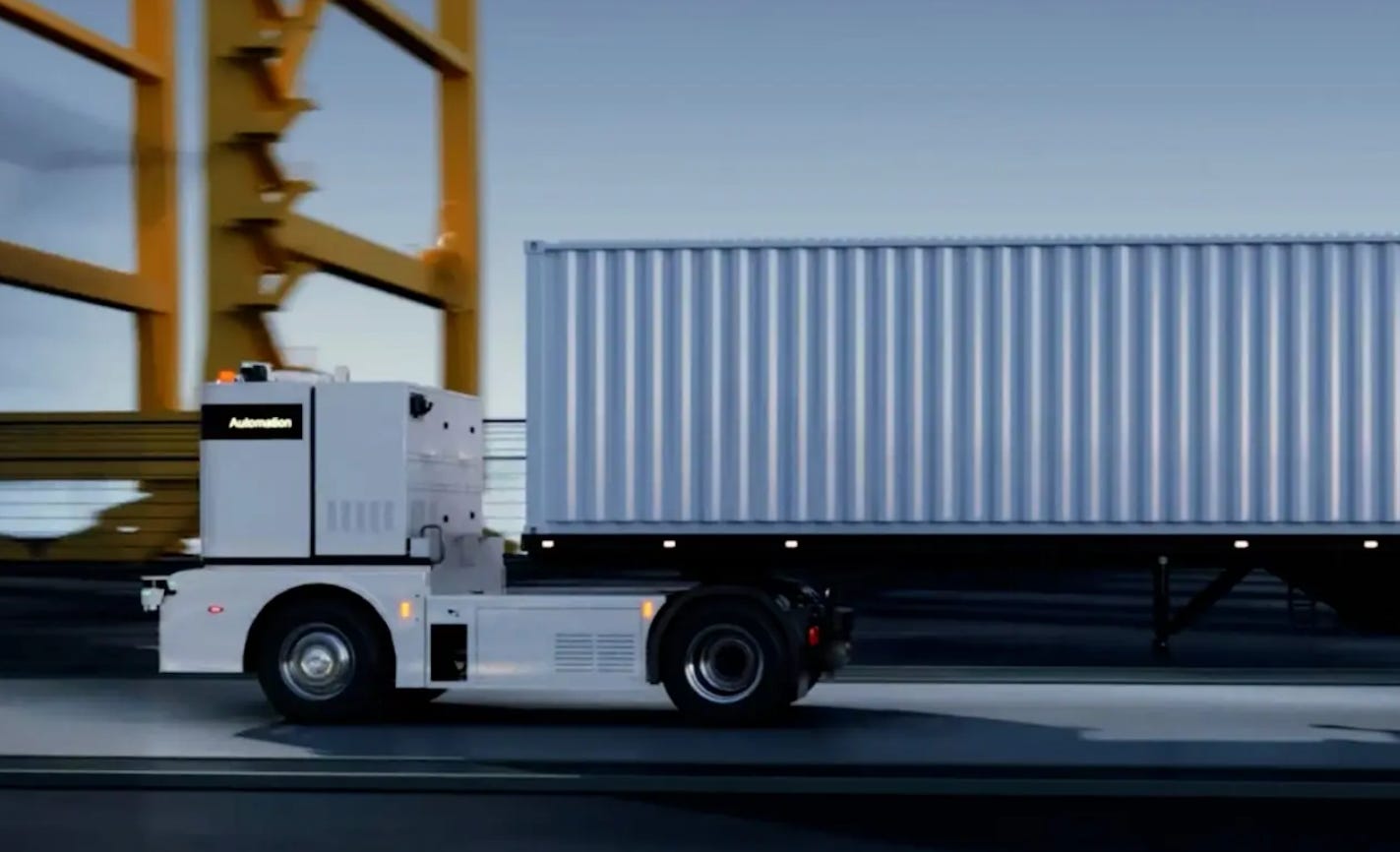
Shanghai-based Westwell is building autonomous trucks for ports. Ports are one of the best places for automation right now, with massive demand for moving things around. It also manages to avoid the “highway problem” mentioned above by maintaining relatively low speeds. This is similar to what Kodiak has been doing, mentioned above: finding an easier, constrained environment where current technology can thrive without major investments in new safety systems, hardening of hardware, better sensors and AI.
Einride - Build From The Ground Up
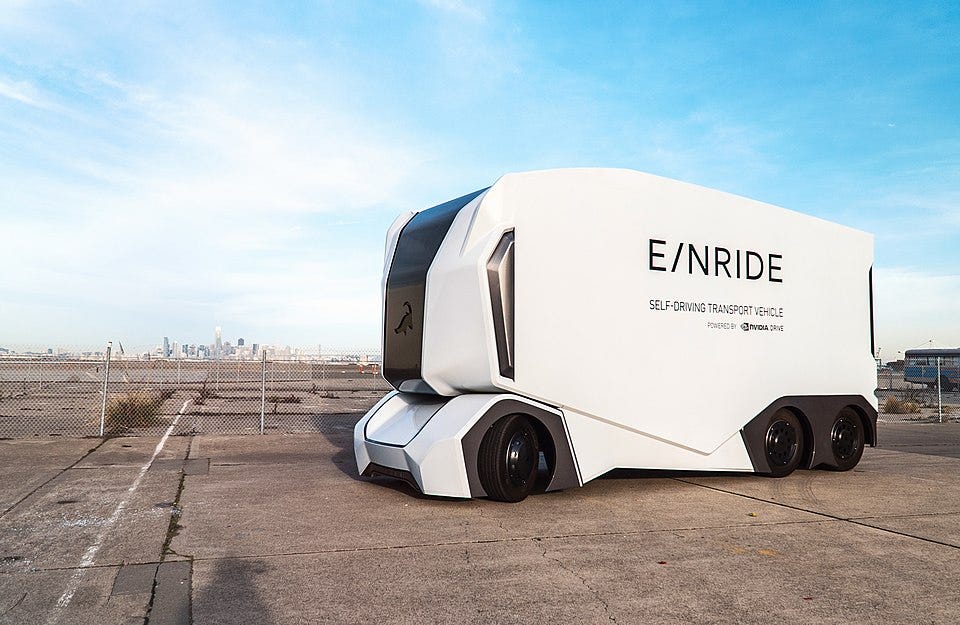
Stockholm-based Einride asks the question, why should it even look like a truck at all? They build a cabless electric truck which can drive around with remote supervision, and have been scaling it to different locations. They’re targeting a fleet of 1,500 to 2,000 vehicles by 2028, with 500 of these being Tesla Semi trucks and most being their own vehicles.
More broadly, much of the trucking system, until now, has been built around humans — see Aurora’s trouble with roadside warning devices. It makes much more sense to develop systems explicitly for autonomy.
Waabi - Go AI First
Founded in 2021, Waabi began after many of the first-wave self-driving semi companies had already died, and at the beginning of the modern AI boom. Unlike many others, they’re focused on developing solutions based on end-to-end learning, using their Waabi World simulator to reach the edge cases and train its system for driving on the road. While they’re still behind Aurora, there’s promising evidence their approach will scale better — they’ve recently demonstrated transfer across vehicles and they raised a $1 billion Series C at the beginning of 2026.
Final Thoughts
Self-driving trucks have faced a long road, but they’re slowly building towards real deployments with real customers. Early signs in simpler, more constrained environments are positive already. Companies like Aurora are now no longer proving their technology can work — instead, they’re proving it can scale economically to large-scale interstate commerce.
I would expect to see more steady expansion in the next year, as we see autonomous trucks moving to more cities, predominantly in China and the US Sun Belt. I still think we’re likely a long way (years) from any self-driving trucks on highways in areas where it might ice, for example. Fortunately, I think there’s nothing fundamental preventing this technology from working — it will just take time, effort, and determination. And, of course, answering the core question facing all of robotics these days: okay, it kind of works; now, can we scale it?
It's very encouraging to hear this progress. One point though: I rode a Waymo on Interstate 280 just a few weeks ago. As I understand it, the issue at SFO involves permission for pick up/drop off on private property, not Waymo's ability to negotiate the freeway.
Good content. Pls note that Kodiak is closing its ARM and launching its long haul program on highways by end of this year.