

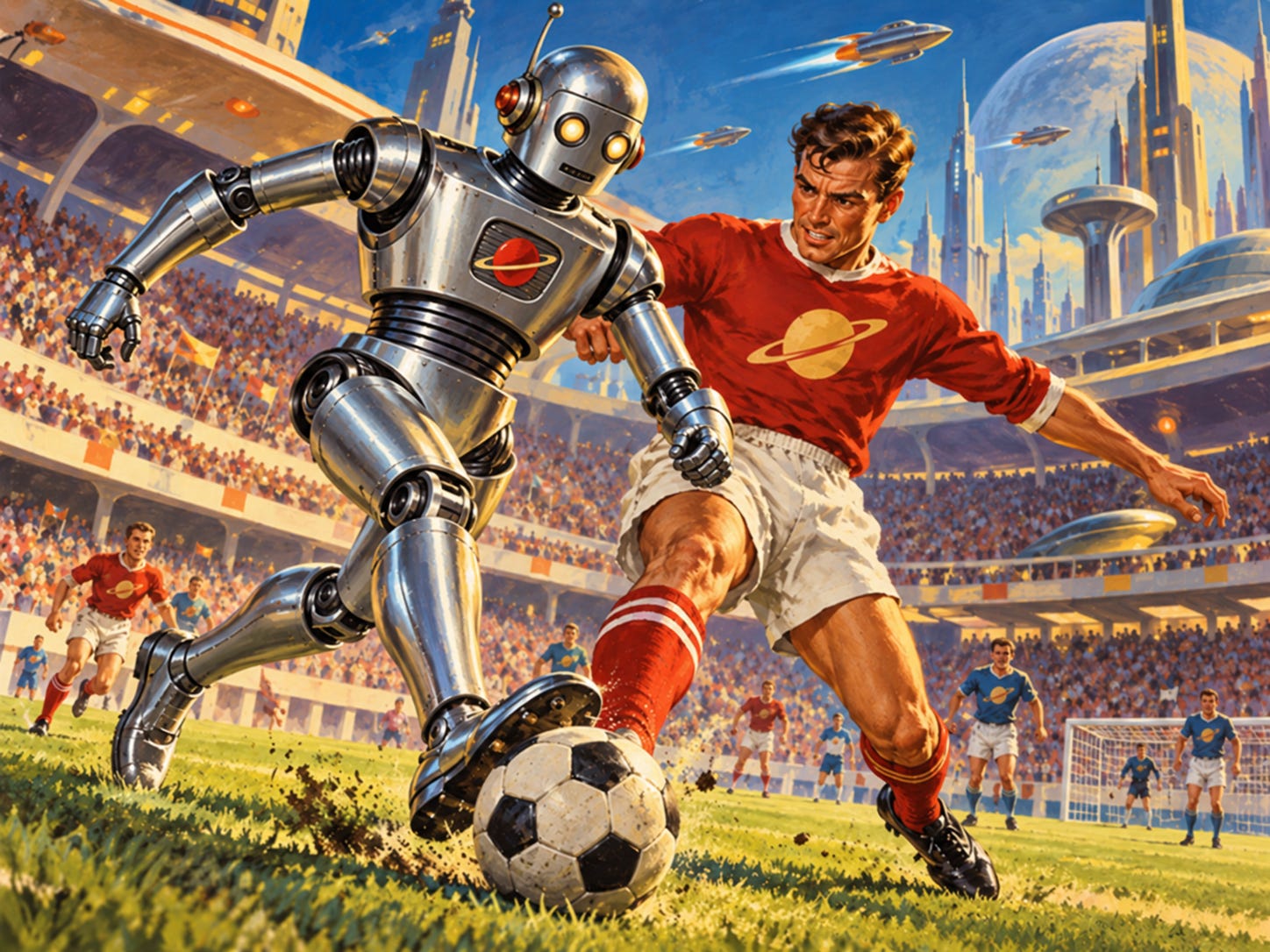
There’s something about watching a robot play a sport that feels different. Most of us do not really know how hard it is to perform, say, a Unitree robot’s crazy dance moves; and mentally we can quickly adjust to the fact that the robots are simply good at dancing. This is helped by the many viral clips of a dancing robot being interrupted and just continuing on doing its thing — it’s clear, in the end, that the robot isn’t actually doing anything, that there’s nothing in there responding to the world around it. It’s just open-loop replay of an action sequence.
But watching robots play sports feels different. A robot that plays soccer has to actually perceive its world and respond quickly to changes in its surroudings. It dashes around, tracks a moving ball, and appears to act as a human might. See, for example, Galbot’s recent IROS 2026 best entertainment paper win.
Robot sports are interesting because they show us three things: (1) dynamic whole-body control; (2) closed-loop decision making; and (3) fast perception and sensorimotor fusion to enable making these decisions. Recent progress has shown incredible progress on (1) and strong improvements on (2) in limited games. But just as important is what we largely do not see: dynamic, high-quality and in-the-loop onboard perception. Even as the control problems of robot sports increasingly look tractable, there are many fascinating problems that we still must address.
Playing Tennis
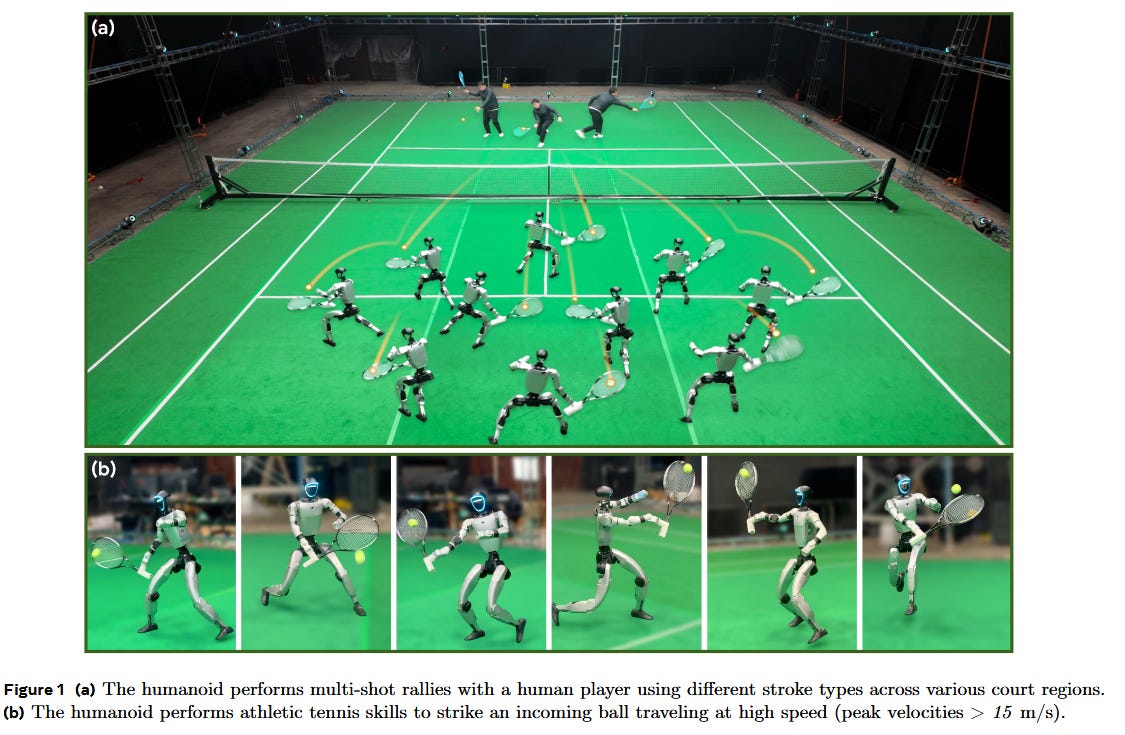
Tennis is a great sport to start with, and it and similar games (ping pong, for example) have a long history in robotics. The appeal is pretty obvious: these games are fairly contact-light, do not involve getting close to humans, but still show the dynamism and precise control necessary for executing a sport. If we cannot make a robot play tennis, one could imagine, it would be difficult to make it perform at a human level at much else.
Google achieved amateur human-level performance in ping-pong with a static robot arm back in 2024 in the paper “Achieving Human Level Competitive Robot Table Tennis,” which is a work that used a library of low-level skills coordinated by a higher-level policy to achieve good, human-level performance (meaning it beat all beginner ping-pong players but still lost to experts).
Playing with a humanoid robot is much more difficult, though. In the Google work, they had access to a highly precise industrial robot arm on a rail, meaning that they have both extremely precise control and a relatively low-dimensional problem to solve. Such an approach can only really apply to ping-pong, which is played at a small table and involves moving not very far.
Humanoid tennis-playing has often used a broadly similar strategy, coordinating multiple components. The 2025 paper HITTER (RoboPapers Ep#41) used reinforcement learning with trajectory prediction to achieve 106 consecutive volleys against a human player on table tennis.
More recently, the paper LATENT won the IROS 2026 best entertainment robotics paper for its work on learning whole-body tennis-playing skills for a humanoid robot, showing a robot dashing around a court and rallying with a human (you can also watch RoboPapers Episode#80 on LATENT now). And Junzhe He of ETH Zurich showed a robot playing badminton.
All this being said, it seems that this type of dynamic, reactive gameplay is now fully achievable with robots. The limitation now appears to be achieving this with onboard perception: many of these systems still use external motion trackers to perceive the ball, which is a huge simplification that would prevent these robots from being deployed to actually play games against humans in the open world.
Solving this may involve new vision approaches, and is not just a matter of attaching a better camera. While many cameras these robots use are far lower resolution than the human eye, current vision-based policies still are likely far too slow to track a fast-moving ball at a distance. Looking back at works like HITTER, we see that trajectory estimation of the ball was in fact an important part of their solution.
Achieving human-level performance under real-world constraints, then, will require fast, precise, low-latency implicit state estimation (knowing where the ball is), from limited onboard sensing, in addition to the precise and fast whole-body control that has already been demonstrated. And this capability would go a long way towards giving robots humanlike capabilities in a wide variety of domains.
Robot Soccer
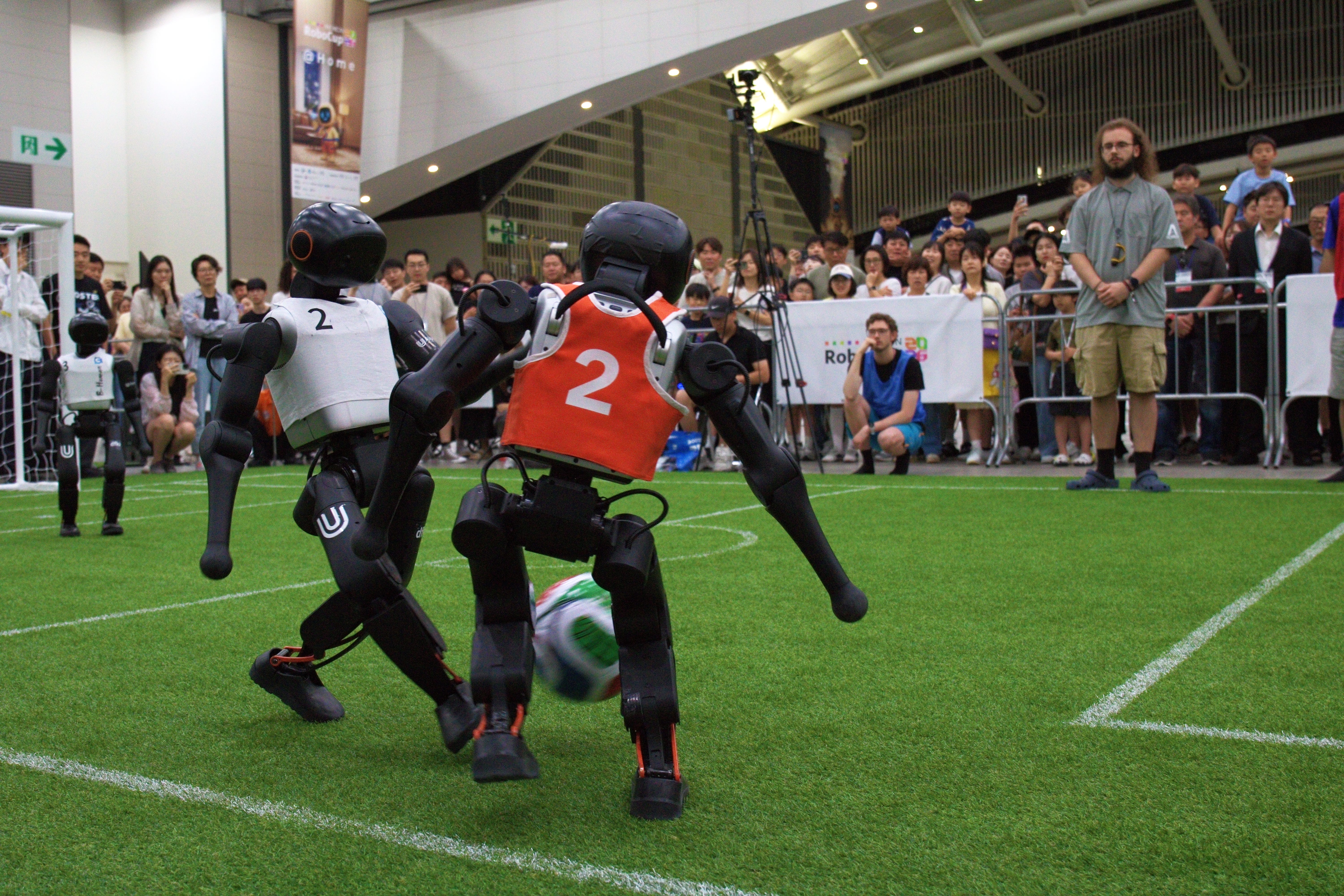
Robot Soccer has a long history, especially as a part of the RoboCup competition which has been going on now since 1997. As compared to tennis (and similar games), soccer relaxes many of the most difficult timing and perception constraints: the ball is much larger and easier to observe, and the game generally will not end if you take a long time to make a decision.
And yet soccer still has a lot of interesting elements: an opposing team with which you will act in close proximity, locomotion over a much larger area, a friendly team with which you can coordinate, and meaningful occlusions and planning problems. It’s that particular combination of both interesting and tractable that makes for good scientific work.
And we’ve seen cool research as a result. Haarnoja et al. at Google Deepmind trained soccer skills in simulation and deployed them on real (miniature) humanoids in their paper “Learning agile soccer skills for a bipedal robot with deep reinforcement learning,” which advanced both multi-agent and sim-to-real reinforcement learning.
And because the perception problem here is actually achievable, in many cases the robots can actually use onboard sensing. One particularly interesting one — still too recent for publication — appears to be Joga, by Nolan Frey et al. While we have to wait for the actual paper to be released, they claim to use the articulated head for onboard tracking of the ball as it moves around. Still a notable gap: playing with multiple other agents, and recovery if you fully lose track of the ball.
And finally, we should note the recent announcement from Skild AI that they’ve achieved strong real-world performance in soccer (though, again, without onboard sensing), through 140 years of self-play in a virtual “world cup.”
Robot Fighting
Finally, I should mention robot fighting. Ultimate Bots (UFB) and Robot Entertainment Kombat (REK) have started putting on a variety of robot fighting matches, usually robot vs. robot but, recently, including a human-vs-robot fight by REK.
These games are quite a bit simpler than the above, with the robot not really responding or reacting at all to the opponent - instead, someone pilots the robot, pressing buttons on a controller as if playing a video game. Indeed, this is part of the fun - these matches often try to give you someone to root for, and UFB will have various people control the robot throughout a game as per a real-world version of Real Steel. Still, these aren’t a showcase of autonomy in the way of the other sports mentioned — at least not yet.
Final Thoughts
There are still relatively few places where robots actually have to dynamically interact with humans in a shared space. Usually robots are kept well away from people; when they do move in close proximity to people, their motions are slow, languid, almost over-cautious. The first times we really see what feels like true, organic interaction between human and robot have occurred in the domain of sports. For this alone, I think they have incredible value.
But also I think robot sports push us to better understand the limits of current technologies. Works like the LATENT paper, above, have to innovate in learning whole-body interaction from human data; they are, I think, genuinely valuable research in addition to being highly entertaining.
And at the same time, robots are pretty cool to watch. The humanoid olympics in Beijing have shown us all kinds of scenes of robot drama, from fiery crashes to record setting victories. Robot entertainment is an actual market that seems to exist now, and that it’s probably the first way the average person will see the new generation of robots. And some clearly see this, with companies like REK and Dollhouse working on robotics that people will actually enjoy seeing.
Finally, we must talk about all the things we don’t see here. Realistic onboard perception is very rare for all of these tasks. Humans, it turns out, are very, very good at sensorimotor control — and in realistic settings, without perfect external eyes to track the ball, it seems like robot sports are still a very long way from human capability. This is precisely what makes these sports so interesting: they show us both how far we have come and how far we still have to go.
The detail that reorganized this for me is the one you put in almost as an aside: most of these systems still use external motion trackers to find the ball. The robot brings the whole-body control and borrows the eyes. So the demonstrations are strongest exactly where the problem was already most tractable, and the missing piece is the one a child has for free.
Your opening says the same thing from the other end. A dancing robot that gets shoved and carries on dancing is not failing at balance, it is telling you there was nothing in there to interrupt. Open-loop replay reads as skill because skill is what normally produces that motion. A ball is the right test precisely because it will not wait for the decision.
The ladder between tennis and soccer is the most useful thing in the piece. Soccer relaxes the timing and gives you a ball big enough to see, so onboard sensing appears in soccer first, which is the reverse of what the impressiveness ordering would predict. Google's arm on a rail beat every beginner and lost to every expert, and the rail was carrying more of that result than the policy was.
Then the last line is the honest one. Humans turn out to be very, very good at sensorimotor control, and nobody notices, because from the inside it never feels like an achievement.
Cool channel. What software do you guys use to record your videos such that the guest can be shown with the screen as well? It's well formatted.